Custom deli paper looks like a simple product: a printed sheet that wraps a sandwich or lines a basket. But because it touches food directly, “food-safe” is not a given, and the phrase covers three separate things that can each go wrong. The base paper has to be free of restricted chemistries, the grease resistance has to be achieved in a compliant way, and the ink you print your brand with has to be formulated and applied so it stays out of the food. Regulation in this area has moved quickly, so if you are ordering printed wrap for a restaurant, food truck, or packaged product, it is worth understanding what actually makes a sheet safe and legal to use.
The PFAS problem and where the rules now stand
For decades, the grease resistance in many paper food wraps came from PFAS, a family of fluorinated “forever chemicals” prized because they repel both oil and water. That chemistry is now being designed out of the food supply. In February 2024, the U.S. FDA announced that manufacturers had stopped selling PFAS-based grease-proofing agents for paper and paperboard food packaging, completing what it described as a voluntary market phase-out, and it reaffirmed that shift in January 2025. The agency framed the move as eliminating the primary source of dietary PFAS exposure from authorized food-contact uses.
Federal phase-out is only half the picture, because states have moved independently and often faster. New York’s ban on intentionally added PFAS in food packaging took effect at the end of 2022, California’s plant-fiber packaging rule followed in January 2023, and a steady sequence of states has joined since. The timeline below shows when a representative set of state bans took effect.
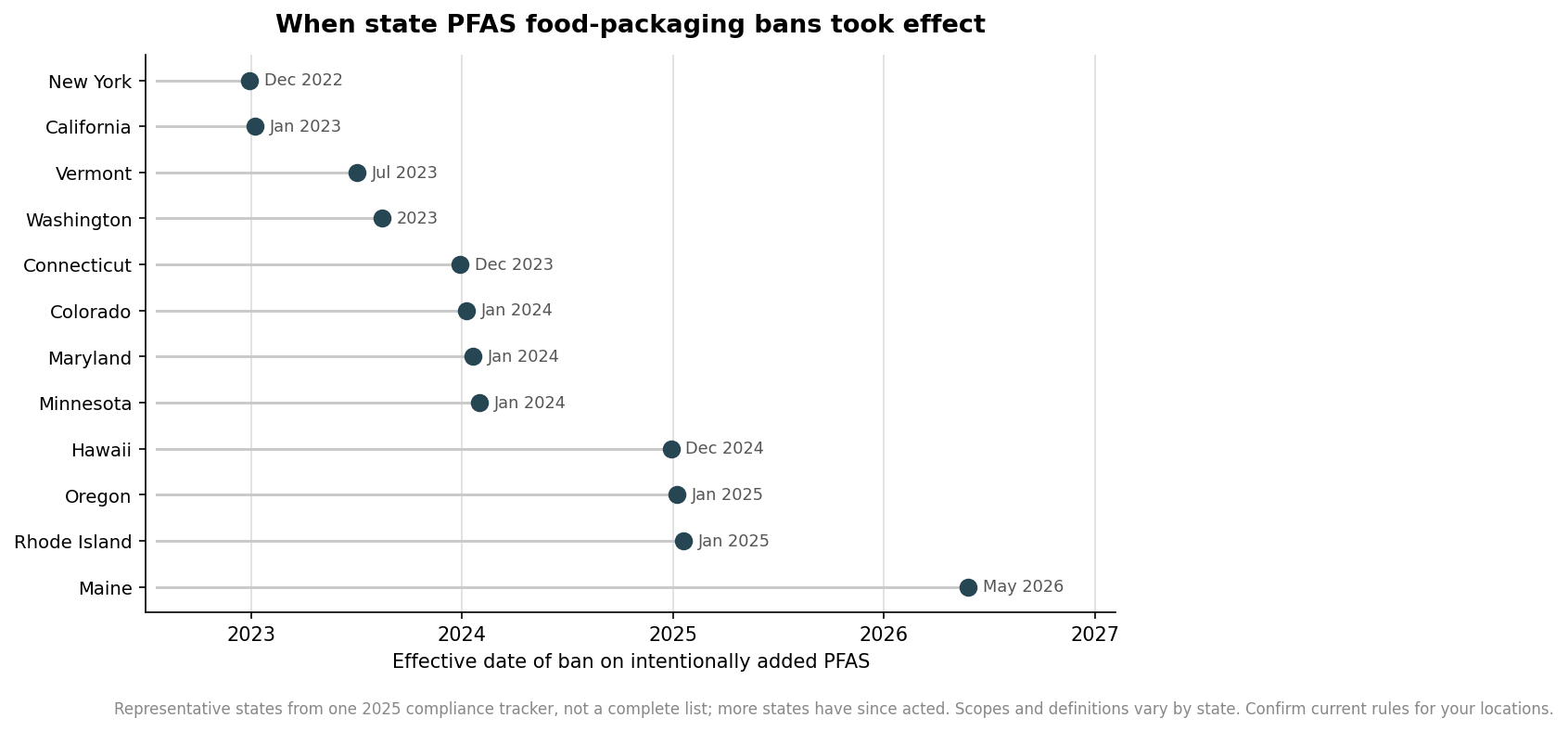
The list is not exhaustive, and scopes differ from state to state, but the direction is unmistakable. Many of these laws target intentionally added PFAS, meaning chemicals deliberately used in manufacturing rather than trace contamination, and some add an objective screen: California, for example, triggers at 100 parts per million or more of total organic fluorine in plant-fiber packaging, which gives buyers and labs a measurable line rather than a judgment call.
Why the ban wave matters for what you buy
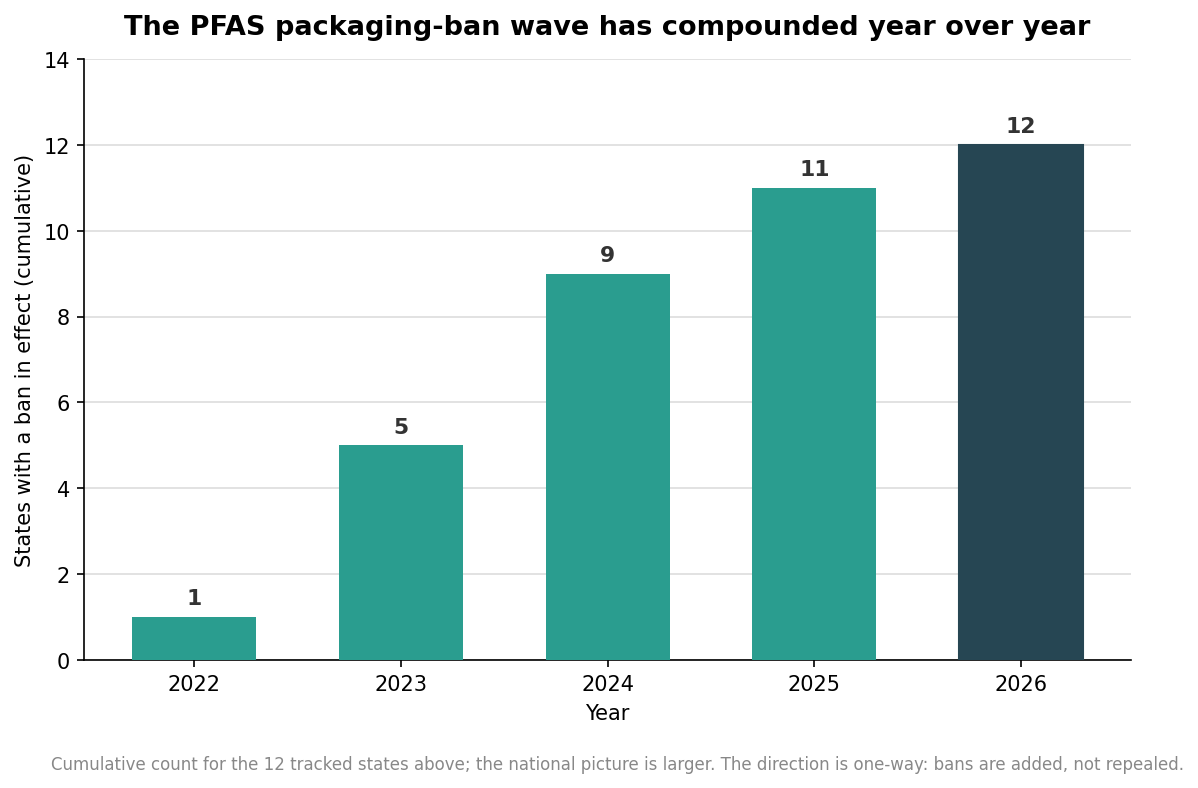
The reason this belongs in a purchasing decision, not just a legal memo, is that the requirements compound. Each year adds more states, the bans are added and not repealed, and a national brand effectively has to meet the strictest rule in its distribution footprint. A wrap that is legal in one state today can be non-compliant in another next quarter, so the practical standard for anyone shipping across state lines is simply to buy PFAS-free and stop tracking the patchwork sheet by sheet.
When you place an order, ask the supplier directly whether the base paper contains intentionally added PFAS and request documentation to that effect, such as a statement of compliance or third-party test results for total organic fluorine. Reputable converters expect this question now. Treat vague reassurances as a red flag: “food-grade” and “eco-friendly” are marketing terms, not compliance statements, and only a specific PFAS-free declaration tied to the actual paper stock tells you what you need to know.
Getting grease resistance without PFAS
Removing PFAS does not mean giving up grease resistance; it means achieving it another way. The most durable approach is mechanical greaseproofing, where the paper fibers are heavily refined and then calendered under pressure into a dense sheet whose tight structure physically resists oil penetration, with no added repellent chemistry at all. Genuine greaseproof and glassine papers work on this principle and are inherently free of fluorinated coatings. Other sheets use non-fluorinated barrier coatings to add oil and moisture resistance, which can also deliver grease holdout while remaining compliant, though the coating can affect recyclability and compostability, so confirm the end-of-life claims separately.
Plain kraft, by contrast, is porous and offers only modest natural grease resistance, which is why it suits dry or low-oil items and drier sandwiches but will show soak-through under a burger or fries. Matching the grease barrier to the actual food is the difference between a wrap that presents your brand cleanly and one that turns translucent before it reaches the customer.
Food-safe printing inks
The print itself is the third safety variable, because ink sits on a surface that may contact food. The goal is low migration, meaning the ink components do not transfer into the food through direct contact, through the gas phase, or by set-off when printed sheets are stacked. Manufacturers control this with low-migration formulations and by managing drying and curing carefully. Common food-appropriate ink systems include water-based inks, which carry minimal solvents and suit kraft and greaseproof stocks; soy and vegetable-based inks, valued for renewable content and strong color; and low-migration UV inks for high-precision printing where transfer risk must be tightly controlled.
Two design decisions reduce risk further: printing on the non-food-contact side where the layout allows, and relying on a functional barrier between ink and food. On the regulatory side, food-contact paper in the United States is governed by FDA 21 CFR 176.170, which sets limits on what may extract from the paper into food; internationally, EU framework Regulation 1935/2004 and overall migration testing under EN 1186 are widely referenced, with a commonly cited overall migration limit around 10 milligrams per square decimeter. You do not need to run these tests yourself, but you should confirm your printer uses food-contact-compliant inks and can point to the standards its inks meet.
What to confirm before you approve a run
Turn all of this into a short set of questions for your supplier. Ask for a PFAS-free statement tied to the specific paper stock, and total organic fluorine test results if you sell into states that screen on it. Confirm how grease resistance is achieved, whether by mechanical greaseproofing or a non-fluorinated coating, and match that barrier to the oiliness of your food. Confirm the inks are food-contact compliant and low-migration, and ask which standards they meet. Getting clear answers to those few questions is what separates deli paper that is genuinely safe and legal to put under food from a sheet that merely looks the part, and it costs nothing but the time to ask before you commit to a print run.