Author: George

  • How to Choose Custom Deli Paper for Your Brand

    How to Choose Custom Deli Paper for Your Brand

    How to Choose Custom Deli Paper for Your Brand: Use Cases and Ordering

    The best way to choose custom deli paper is to start from how they will be used, then work back to the material, size, and decoration that fit. Custom deli paper serve very different jobs across food service, e-commerce inserts, retail & branding, and events, and matching the order to the job is what makes custom deli paper feel purpose-built rather than generic. This guide maps the common use cases and walks through ordering custom deli paper that fit your brand.

    Whether the deli paper protects a product, presents a gift, or carries a logo into the world, defining that job first keeps every later decision easy. Purpose drives the spec, and the spec drives the result.

    How brands use custom deli paper

    Custom deli paper get ordered for a mix of protection, presentation, and promotion, and knowing where yours fall points you to the right build. The breakdown below shows the common uses, from food service to events.
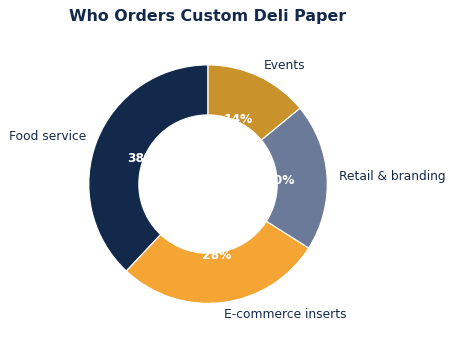
    The common ways brands put custom deli paper to work.
    The common ways brands put custom deli paper to work.

    Most orders lean toward one primary job with a secondary benefit — a shipping-focused deli paper that also brands the unboxing, or a gift-focused one that also protects. Naming your primary use keeps the order focused and the spec appropriate.

    Use case What it needs
    Food service branded, food-safe paper that dresses up a serve
    E-commerce inserts thank-you and instruction cards that build loyalty
    Retail & branding labels and wraps that reinforce the brand
    Events printed pieces that tie a theme together

    Matching material and size to the use

    Once the use is clear, the material and size follow. A protection-first job favors a durable, well-fitted build; a presentation-first job favors a premium material and a clean print; a promotion-first job favors a cost-effective option you can order in volume. Sizing to the product with a small margin keeps the deli paper looking intentional and performing its job.

    If a single order serves more than one use, spec to the most demanding one so the deli paper performs everywhere. It is easier to use a slightly sturdier or more premium deli paper across the board than to discover a bargain option falls short for your most important use case.

    Branding for the impression you want

    Decoration should reinforce the impression the use calls for. Digital and offset printing reproduce full-color art crisply, with spot colors and foil available for a premium touch. For a premium or gift use, lean on finishes and restraint; for high-volume promotion, prioritize a bold, legible logo that reads at a glance and reproduces affordably at scale. Keep branding consistent with the rest of your packaging or merch so everything reads as one system.

    The most-requested options below reflect what buyers reach for most, and they are a useful starting menu when you brief your order. Whatever you choose, approve a proof so the finished custom deli paper match the impression you intended.
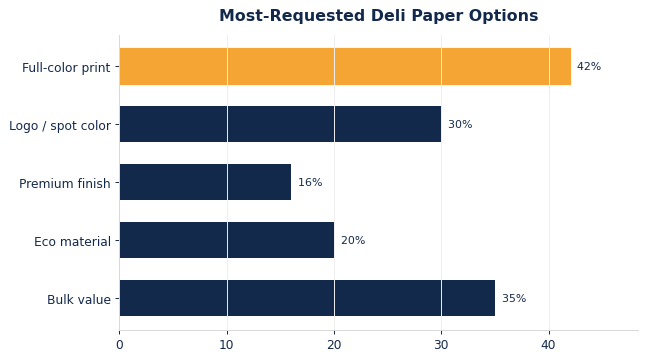
    The options buyers request most on custom deli paper.
    The options buyers request most on custom deli paper.

    Getting the size and details right

    Even with the use and material decided, the details are what make custom deli paper feel finished. Confirm the size and weight against the product with a small margin, check the print area for your chosen size so the logo sits cleanly, and decide on any finishing touches before you brief the order. These small confirmations up front are what separate a deli paper that looks intentional from one that looks close-enough.

    A sample or proof is the cheapest insurance you can buy on a deli paper order. A physical sample lets you judge the material and print in hand, while a digital proof confirms artwork, color, and size and weight before the full run. Spending a few minutes here prevents the far larger cost of reworking a finished order of custom deli paper that missed on a detail.

    Ordering: quantities, lead time, and reorders

    A smooth deli paper order comes down to a few basics: order for real demand plus a small overage, send print-ready artwork early, and confirm lead time against any deadline so production and shipping fit your timeline. Per-unit cost drops with volume, so consolidating a season’s needs into one run is usually more efficient than repeated small orders.

    Keep your approved artwork and spec on file so reorders are a quick repeat rather than a fresh setup each time — consistency across runs keeps your brand looking deliberate.

    Coordinating with the rest of your brand

    Custom deli paper rarely stand alone; they sit alongside your other packaging, print, or merch, so coordinating them strengthens the whole brand. Carrying the same logo, colors, and tone across your deli paper and your other pieces makes everything read as one deliberate system rather than a set of one-off orders. That consistency is what makes a brand feel established, and it costs nothing extra to plan.

    Coordination also simplifies buying over time. Standardizing on a material, size, and decoration you are happy with turns future orders into simple repeats, and it keeps every batch matching the last. A little upfront alignment pays back every time you reorder custom deli paper.

    Frequently asked questions about custom deli paper

    What are custom deli paper used for?

    Custom deli paper serve a mix of protection, presentation, and promotion across food service, e-commerce inserts, retail & branding, and events. Most orders lean toward one primary job with a secondary benefit, so naming your main use is the first step in speccing the right deli paper.

    How do I match custom deli paper to my use?

    Let the use drive the spec: durable and well-fitted for protection, premium and clean for presentation, cost-effective and bold for promotion. If one order serves several uses, spec to the most demanding one so the deli paper performs everywhere.

    How should I brand custom deli paper?

    Digital and offset printing reproduce full-color art crisply, with spot colors and foil available for a premium touch. Choose finishes and restraint for premium or gift uses, and a bold, legible logo for high-volume promotion, keeping the branding consistent with your other packaging or merch so it all reads as one system.

    How far ahead should I order custom deli paper?

    Order for real demand plus a small overage, send print-ready artwork early, and confirm lead time against any deadline so production and shipping fit your timeline. Consolidating a season’s needs into one run is usually more efficient than repeated small orders.

    Can I reorder easily?

    Yes. Keeping your approved artwork and spec on file makes reorders a quick repeat rather than a fresh setup, and it keeps every batch of custom deli paper matching the last for a consistent brand look.

    Do I need a sample before ordering custom deli paper?

    A sample is worth it for a first order or a new material, since judging feel and print in hand removes the guesswork. For a straightforward reorder of custom deli paper you have bought before, a digital proof confirming artwork and size and weight is usually enough.

    Match the deli paper to the job, spec it deliberately, and approve a proof, and your order will do exactly what you needed. For the full material and sizing breakdown, see our companion guide, our Custom Deli Paper: Materials, Sizing & Branding Guide, and browse our our shop to get started.

    Not sure which custom deli paper fit your use?

    Tell us how you’ll use them and we’ll match the material, size, and branding to the job.
    Get a Quote

  • Custom Deli Paper: Materials, Sizing & Branding Guide

    Custom Deli Paper: Materials, Sizing & Branding Guide

    Custom Deli Paper: A Materials, Sizing, and Branding Guide

    Getting custom deli paper right comes down to three decisions: the material, the size or spec, and how you brand them. Make those well and you end up with custom deli paper that protect and present your product, reinforce your brand, and land on budget. This guide walks through the material options, how to size and spec your order, and how to decorate custom deli paper so they do real work for your brand rather than just checking a box.

    Whether you are ordering your first run or reordering at scale, the same fundamentals apply. Choosing custom deli paper deliberately — material to job, size to product, decoration to brand — is what separates an order you are proud of from one you settle for.

    Why custom deli paper matter for your brand

    Custom deli paper are more than a commodity; they are a touchpoint brands experience directly. A well-chosen, well-branded option signals quality and attention to detail, while a generic one quietly undercuts an otherwise strong product. Because custom deli paper are seen and handled, they carry your brand into the world every time they are used.

    That visibility is exactly why it pays to spec custom deli paper intentionally. The material sets the feel, the size sets the fit and cost, and the decoration sets the impression — and getting all three aligned turns a functional item into a genuine brand asset.

    Materials and options compared

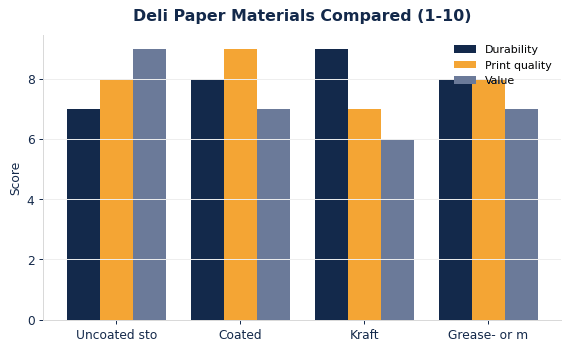
    The common materials for custom deli paper each trade off durability, print quality, and cost: uncoated stock, coated / gloss stock, kraft / recycled, and grease- or moisture-resistant. The right pick depends on how the deli paper will be used, the look you want, and your budget. The chart and table below compare the main options so you can match material to job.

    How common deli paper materials compare on durability, print quality, and value.
    How common deli paper materials compare on durability, print quality, and value.

    As a rule of thumb, choose a recyclable or natural material when eco positioning matters, a coated or laminated option when you want vivid full-color print, and a premium build when the deli paper is part of a gift or high-end presentation. When in doubt, request a sample so you can judge feel and print before committing to a full run.

    Material / option Best for
    Uncoated stock natural, writable surface with a matte look
    Coated / gloss stock vivid color and a polished finish
    Kraft / recycled eco-forward, warm natural tone
    Grease- or moisture-resistant food-safe performance where needed

    Sizing and specs

    Sizing is where many deli paper orders go wrong, so measure before you order. Custom deli paper typically range from a small insert card up to a full wrap or liner sheet, and the right size and weight depends on the product or use they serve. Too small and the fit is tight or the product is exposed; too large and you pay for material you do not need and lose a clean, intentional look.

    When a measurement falls between standard options, size to the product with a small margin rather than guessing. Confirming the size and weight on a proof or sample before a large run prevents the costly mistake of a full order that does not fit, which is far more expensive to fix than a five-minute check up front.

    Branding and decoration

    Decoration is what turns a plain deli paper into a branded one. Digital and offset printing reproduce full-color art crisply, with spot colors and foil available for a premium touch. Match the method to your artwork and budget: simple logos reproduce cleanly and cheaply, while detailed, full-color designs shine with the right process on the right material. Keep the artwork vector where possible and confirm the print area for your chosen size.

    Restraint usually reads as premium. A clean logo, one or two brand colors, and quality material almost always look more considered than a busy, over-printed design. Approving a proof before the run protects both the look and the budget, especially on a large order of custom deli paper.

    Ordering and budget

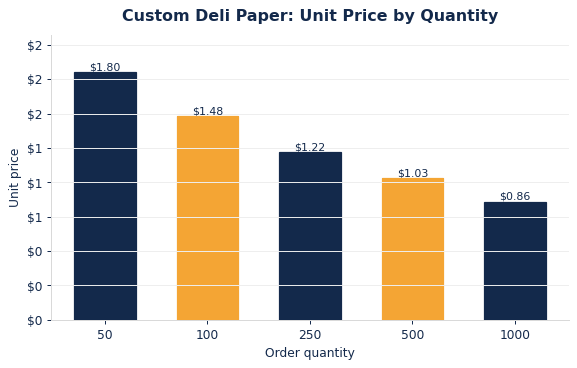
    Per-unit cost on custom deli paper falls steadily with volume as setup amortizes across more pieces, so ordering for real demand rather than a token first batch is usually the efficient move. The curve below shows how pricing typically improves with quantity, which helps you plan an order that balances cash and cost.

    Typical per-unit deli paper pricing as order quantity increases.
    Typical per-unit deli paper pricing as order quantity increases.
    Ordering for a recurring need? A single larger run lowers the unit cost and keeps your branding consistent, while a small overage covers reorders and the occasional damaged piece without a rush order.

    Common mistakes to avoid

    A few avoidable missteps account for most disappointing deli paper orders. Ordering before measuring is the biggest, followed by choosing a material for price alone without considering how the deli paper will actually be used, and skipping the proof on a large run. Each is easy to prevent with a few minutes of planning, and each is expensive to fix once a full order is produced.

    The other common trap is over-designing the artwork. Cramming in too many colors, effects, or details can muddy the print and raise the cost, especially on textured or recycled materials. Simplifying the design to a clean, legible mark almost always improves both the look and the price of your custom deli paper.

    Frequently asked questions about custom deli paper

    What material is best for custom deli paper?

    It depends on the use: choose a recyclable or natural material for eco positioning, a coated or laminated option for vivid full-color print, and a premium build for gifting or high-end presentation. Request a sample to judge feel and print before a full run of custom deli paper.

    How do I choose the right size?

    Measure the product or use the deli paper serves, then size to it with a small margin so the fit is clean without wasting material. When a measurement falls between standard options, size up slightly and confirm the size and weight on a proof before ordering in volume.

    How are custom deli paper branded?

    Digital and offset printing reproduce full-color art crisply, with spot colors and foil available for a premium touch. Match the method to your artwork and budget, keep the art vector where possible, confirm the print area for your size, and approve a proof so the finished custom deli paper match your intent.

    How does pricing work, and is there a minimum?

    Per-unit cost drops with quantity as setup amortizes across the run, so larger orders are more cost-effective. Order for real demand plus a small overage rather than a token batch, and consolidate recurring needs into one run for the best price.

    Can I get a sample or proof before ordering?

    Yes, and it is strongly recommended. A physical sample lets you judge material and print, and a digital or physical proof confirms your artwork, color, and size and weight before a full run — a small step that prevents a costly mistake on a large order.

    What do you need to quote custom deli paper?

    To quote accurately we need the size and weight or the product they serve, the quantity, your material preference, and your artwork or a description of the branding. With those details we can recommend the right material and size and give you pricing for the run, and a proof follows once the order is confirmed.

    Whatever you order, send vector artwork, confirm material and size and weight, and approve a proof before production. For help matching custom deli paper to a specific use, see our companion guide, our How to Choose Custom Deli Paper for Your Brand, and explore our our shop to start your order.

    Ready to order custom deli paper?

    Tell us your product, quantity, and branding and we’ll match the material, size, and decoration for you.

    Get a Quote

  • How Much Custom Deli Paper Should You Order?

    How Much Custom Deli Paper Should You Order?

    Custom deli paper is cheap per sheet but ordered in the thousands, so the real question is how many sheets your kitchen actually burns in a week. Here is the counting method and the order sizes that keep your cost per sheet at the bottom of the price curve.

    Count sheets per service, not per day

    Walk one lunch rush and count every use: basket liners, sandwich wraps, tray liners, scale sheets, and the ones torn off and thrown away. Multiply by your services per week. Most single-location delis land between 1,500 and 4,000 sheets a week; food trucks usually run 800–2,000.

    Order tiers that make sense

    Weekly use First order Coverage
    Under 1,000 10,000 sheets ~3 months
    1,000–2,500 25,000 sheets ~3 months
    2,500–5,000 50,000 sheets ~4 months
    Multi-location 100,000+ central storage, quarterly

    Printed deli paper prices fall steeply with volume because plate setup is a fixed cost — the same artwork on a 50,000-sheet run can cost half as much per sheet as a 10,000-sheet run.

    Storage is the easy part

    A case of 5,000 flat sheets is about the size of a copy-paper box and stores dry at room temperature indefinitely, so ordering deep carries little risk. Just keep cases off the floor and away from the fryer line’s grease mist.

    Time the reorder to the lead time

    Custom runs take about two weeks to produce and ship. Reorder when you open your last month of stock and you will never have to serve on plain white paper while the branded run is on a truck.

    Design your custom deli paper

    Tell us your sheet size, paper type, and artwork and we will send a free mockup and per-sheet pricing within one business day.

    Get a Quote

    Home · About · Blog

  • Greaseproof vs. Kraft Deli Paper: Picking the Right Sheet

    Greaseproof vs. Kraft Deli Paper: Picking the Right Sheet

    The sheet under the sandwich does more work than most owners realize: it controls grease, keeps baskets clean, and carries your logo onto every table and Instagram photo. Here is how greaseproof and natural kraft compare, and which menu items call for which.

    What each paper is

    Greaseproof paper is treated so oil cannot soak through — the sheet stays crisp and the print stays sharp under fried food. Natural kraft is untreated brown paper: rustic, compostable-looking, and cheaper, but it absorbs grease and darkens where hot food sits.

    Match the paper to the menu

    Menu item Best sheet Why
    Fried chicken, fries, smash burgers Greaseproof blocks soak-through
    Cold sandwiches, bagels, pastries Natural kraft rustic look, lower cost
    BBQ trays, cheesesteaks Greaseproof kraft brown look + oil barrier
    Charcuterie, bakery counter Either styling choice

    Print and food-safety notes

    Both papers take custom printing with food-safe inks. On white greaseproof, colors reproduce brightest; on kraft, dark single-color prints (black, deep red, forest green) look best and hide grease shadows. Every sheet we print is FDA-compliant for direct food contact.

    The practical answer for most kitchens

    If your menu leans fried or hot, run greaseproof as your main sheet and keep kraft for bakery and cold items. If you are cost-driven and mostly cold, flip it. Many shops split an order across both papers with the same artwork — the brand stays consistent and each item gets the right sheet.

    Design your custom deli paper

    Tell us your sheet size, paper type, and artwork and we will send a free mockup and per-sheet pricing within one business day.

    Get a Quote

    Home · About · Blog